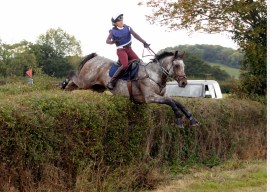
Frank passed his five stage vetting when I bought him three years ago (April 2014) with an advisory that his left foot might need remedial farriery – it is a slightly different shape from his right foot. Very few horses have perfectly symmetrical feet apparently. I had a chat with a farrier about this recently who explained that when young horses are grazing the awkward stance they adopt of one foreleg way out in front and the other way out back – to allow them to reach the grass – is thought to affect the shape and position of the pedal bone and hence the hoof. It is thought that this position may pull unevenly on the pedal bone and can result in some distortion of the hoof. The shape and position of the pedal bone determines the shape of the hoof. Remedial work is only effective up until the horse is 18 months old – after this time the shape of the pedal bone and hoof is set for good. Hmmmm….. discuss!
Sicknote
Whilst my grey Anglo Arabs totters are as hard as nails Franks feet are rather flaky. They always have been and he has sensitive soles. It is two weeks now since Frank bruised his sole cantering through a water complex. Each day I kept hoping he would come sound but as I watched him in the field I could see he was still walking wounded. Just the other day though some one spotted him running around the field without his crutches so I knew it was time to get back on. I started riding him again and began to feel optimistic again. The very next day though, however, he pulled a shoe off in the field. My friend, who brought him in, called me to let me know but couldn’t recall which trotter was now barefoot . They had found the shoe in the field all bent and twisted. I had a sinking feeling when I heard this… It was bound to be the left shoe. The left shoe was slightly too large for his foot as the farrier had had some difficulty finding enough wall to nail the shoe to. This would make the shoe more vulnerable to being trodden on and pulled off. Frank had been shod only a week ago – three days before he bruised his sole – it must have taken some effort to wrench that off and bend it. Shit. Frank cast a shoe last year warming up for a ODE – as the shoe detached, Frank trod on one of the nails and punctured his sole. It took six weeks to recover. Looks like I would have to cancel Homme House ODE which was to be our first attempt at a BE 90. It was with some trepidation at what I might find when I arrived at the yard to inspect the damage. Looking over the stable door I tried to see which foot was shoeless but his trotters were obscured by shavings – I thought I could just make out the toe clip on the right foot but no – that was particularly large and clean shaving. As I approached more closely I was relieved to see a shoe on the left foot! TF for small mercy’s.
About three months ago I decided, against my better judgement, to start Frank on a hoof supplement. I have flaky nails – they’ve never been any good and it doesn’t matter how much gelatine I eat or how much nail hardener I paint on – oh the money I have wasted. I will ensure Frank receives the optimum dose, every day, for at least a year. As they say, watch this space. There are so many variables that can affect horn strength such as environment, climate/weather, time of year, general health, nutrition, genetics…. that it can be difficult to know which one of these variables is the most important. Talking to a friend about her horses flaky feet it was recommended that I try anti-bac. This topical liquid (Idoloform and eucalyptus) is applied twice a week to nail holes and clenches to treat mild bacteria infection which can compromise the strength of the hoof wall. Hoof oil has mild anti-bacterial properties so I have decided to use this too and apply cornucrescine to the coronary band. This is easy in the summer months but will I be able to keep this regime up in the winter along with battling with rain, swamp conditions, mud fever and dark nights. Could mild bacteria be causing the hoof wall to crumble? Frank is susceptible to mud fever at any time of year – the bogs and ditches never dry up so there’s always somewhere for the bacteria to thrive – the bacteria-flaky feet connection seems plausible. I’ll let you know if there’s any change in the trotters….

