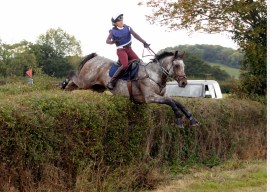
Two days of Ian Wright training. So, what have I learnt and am I making progress? Frank and I have been out for a 10 minute warm-up circuit around the village so when we get into the school I take up a contact and fairly quickly move towards getting Frank working in an outline. We establish a good working trot and Franks head looks in the right place. I can see the headpeice of the bridle and I can see his inside eye – so we have some flexion to the inside. My inside leg is on the girth – to give him something to bend around – every now and then I apply a bit of pressure with the outside leg. And me – what is my position like? Am I sitting up tall, shoulders back, heels down? I mustn’t let Frank pull me forward – be ready for it if he tries it on. Valegro would never do that to Charlotte… Ah Charlotte Dujardin…. think about how Charlotte would look….Oh yes, that visualisation helps. Hands are a pair – together – thumbs uppermost – are my reins short enough, is there enough bend in my elbows? Oh Frank’s head is going down now – quickly – raise the hands…. not too much though – ah, it’s OK, beak back in the right place. Nice. Let’s change the rein from right (best side) to left (wonky shopping trolley side). I ask for canter and he strikes off on the correct left canter lead – which is great because three months ago this was almost impossible to achieve. The very first lesson I’d had with Ian corrected this problem immediately – where all others had failed. Having cantered on both reins changing the lead across the diagonal I was feeling pretty pleased with Frank. I thought Ian would be pleased too. We have been practising since our last lesson six weeks ago. As I walk over to Ian he tells me Frank is not forward enough. “He’s not riding into the bridle” Ian pointed out. In other words, he’s not going forward with enough impulsion and as a result he’s not straight. He’s not taking a strong enough pull on the reins, he’s too light. It’s not just front end problems – he’s not working from behind either – well not enough. Oh God, I thought…. we were going so well? Yes? No? I know what Ian is getting at, I understand what he is trying to tell me – but I thought for a moment that we had it… I thought we were doing OK. … haven’t we made progress? Lets just rewind and have some deets re Frank’s background…. three years ago I bought this dappled, lanky, handsome creature from Forest of Dean. He was produced for sale by the brilliant Charlotte Armstrong (Armstrong Equine – see reviews on facebook) he was eight and up until now had been a show horse. He’s 16.2 bay roan by Pocketed (TB/ US) out of Robe Westfield Lass (Connie) from Chorley. He was the first horse I went to see and I fell in love instantly. He’s tall and skinny, like Russell Brand of the horseworld, or if he were a human I reckon he’d be the Fonz. He was a bit Fomula 1 to begin with and used to get quite excited and boil over a bit when showjumping. I had my hands ( and legs) full. I found he had a tendency to curl up and go overbent (possibly due to being schooled in draw reins) and would pull me forwards, then scoot off. He was inconsistent and we lacked rhythm and harmony – I was not much more than a passenger. Since day one I have been trying to ride him from the seat and legs into the bridle, to get engagement of the hind legs, to lift the front end. He still feels the need to to check up on his penis but not quite so often – as far as getting him into the frame goes we are not there yet.
The issue of connection has been discussed elsewhere in this blog and I found this explanation in the free download book from Kathy Farrokhzad Horse Listening blog (How to recognise and improve essential riding skills). This explains very well I think what Ian was trying to help me achieve with Frank. I can listen to my trainers explanation and get it, I can read about it here in Kathy’s work and get it, I can see it in my minds eye and imagine what it must feel like, I can even feel it in a few strides when I’m riding Frank but feeling it and keeping it there is like trying to hold jelly in place. Kathy explains below about feeling the forward thrust of energy and letting it come through but as Mary Wanless also explains in ‘Ride with your Mind’ this forward energy has to be contained – like squeezing toothpaste out of a tube – once your legs and seat have generated the energy from behind your hands need to contain this energy to prevent it from just disappearing out of the front like the toothpaste out of the tube. Mary has been writing and teaching now for a couple of decades I have read her books and attended a couple of training courses and incorporate much I what learnt from her approach into my riding. Writing this makes me feel I should maybe re-visit her work. It is helpful to read about riding and instructional to watch YouTube videos (Carl Hester, Emile Faurie, Anna Ross-Davies to name a few). What you read and watch has to be synthesised into what you feel when you ride your horse and lessons and coaching consolidate this. Progress comes with practice. Trying to remember what the coach said yesterday or last week isn’t easy. Hopefully, training and lessons complement one another. Often we find ourselves riding at the end of a very busy day or week and this endeavour is not something that can be achieved with just the dog-end of your energy. This is why, if you are serious about riding and improving, you have to get fit, keep fit, eat well, sleep enough and try to avoid injury.
“1. Half-Halt
In order to truly “round” a horse – versus “frame” a horse – you want the
energy to come over the topline. You want to feel the forward thrust of the
energy that seems to energize rather than stifle. You want to let that energy
come “through” rather than stop it.
But you can’t exactly let it all go either.
Aye, there’s the eternal rub.
Regardless of your rein length, and your riding discipline, you can’t
“drop the connection” if you want to contain energy. Well, unless both you
and your horse are at a level of self-carriage that allows you to control your
balance with nothing but seat, leg and weight aids.
We will assume that we are not at this level” (Kathy Farrokhzad, Rider Problems book downloaded August 2017).
Frank is less overbent these days but we haven’t eliminated it entirely and every now and again he likes to look and check up on the old chap. As soon as I feel he’s about to curl up then I put my leg on, sit deep, push forward and raise my outside hand. When his head (and neck and back) are in the right position and his he is working from behind then I turn the volume down ever so slightly on the aids always ready to turn them up again. This whole business reminds me of trying to get the correct water temperature out of a shower head attached to bath taps (only older readers may get this). This task was almost impossible as water temperature veered from icy cold to steaming hot completely bypassing the ‘just right’ stage. There was real skill and patience involved in tweaking the hot and cold taps ever so slightly – the real knack was in knowing just how long to wait before making any adjustments and in knowing exactly how much to turn each tap off or on…was so frustrating – thank goodness for invention of the electric shower. This exercise is akin to that of trying to establish a good and constant contact with the horse – substitute hot tap for legs and cold tap for hands. This crude ‘thermostat’ analogy demonstrates just how tricky establishing and maintaining good contact can be. In response to the thermostat we have to make a number of tiny and subtle (maybe some not so subtle) adjustments – with our hands, upper body, seatbones, and legs. These adjustments have to be made immediately, the level of adjustment has to be just right – feedback from our horse tells us how much is too much and how much is not enough. We have to be able to feel that feedback and know instantly what action to take. When you break it down, there is a complex interaction going on here between horse rider and environment – no wonder riding is so difficult. Add into this mix unpredictable factors as the horse spooking, losing concentration, having an off day and other factors such as rider bio-mechanics, balance, strength, and asymmetry (horse and rider) and the process becomes increasingly complex. The truth is we don’t live long enough to be able to ride our horses perfectly.
Kathy points to the difficulties of making this connection – reading about these difficulties and trying out suggested advice for overcoming these is something I’m going to be concentrating on with Frank. I’ll let you know how we get on.
Big Glove
Jlz & Frank
 Only Joolz and Horses